

Expoquimia 2026: Micromotion in water analysers
Regner® Editorial Team
Aiguaviva -
14/07/2026
Micromotion is driving the next generation of water analysers
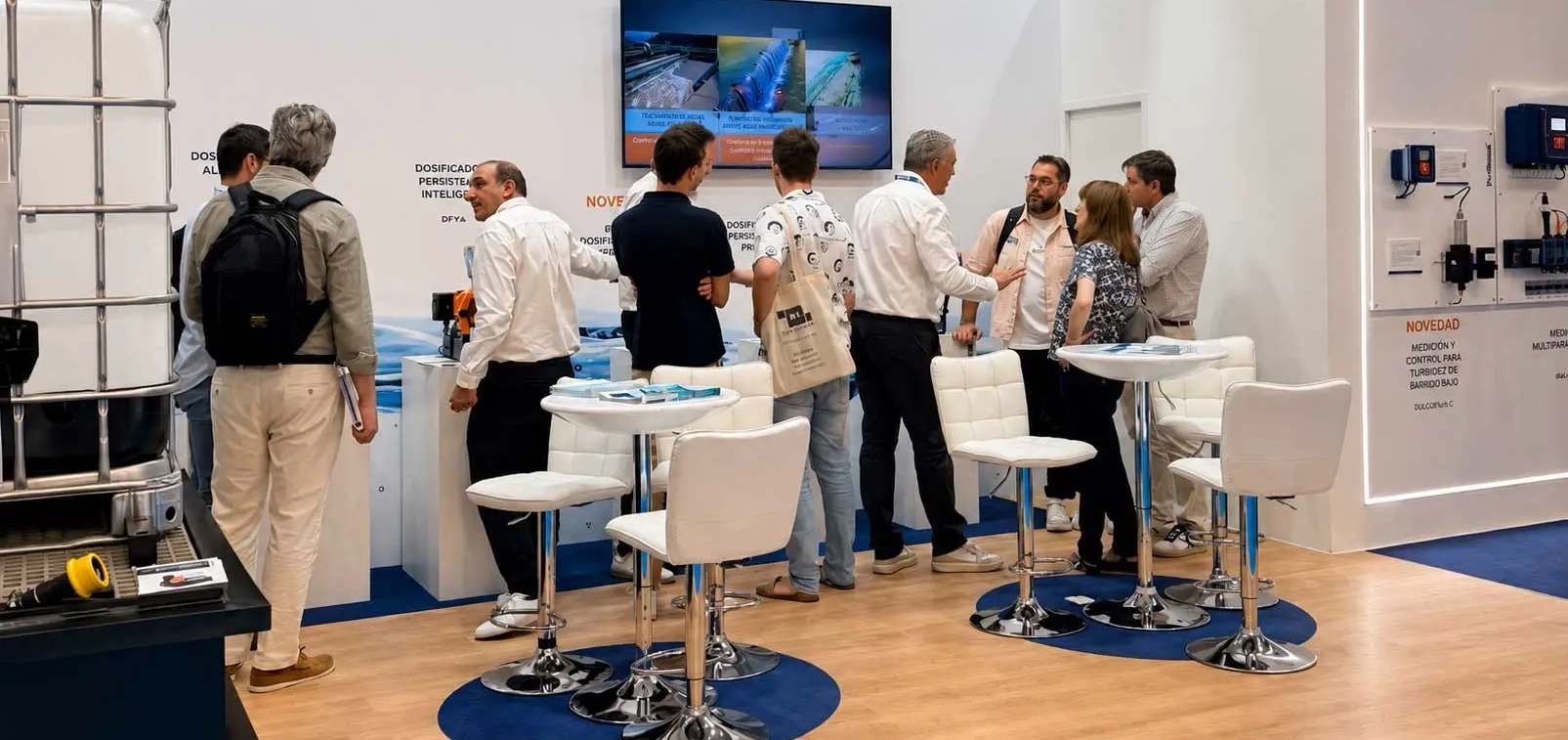
Held in Barcelona from 2 to 5 June 2026, Expoquimia once again brought together leading companies, technology centres and professionals from the chemical industry and process instrumentation sector.
This year’s event confirmed a transformation that has been developing for several years: the water analyser is evolving from a simple measuring instrument into an intelligent, connected and increasingly autonomous platform.
The exhibition featured solutions for drinking water analysis, wastewater treatment, industrial processes and environmental monitoring. All of them shared common objectives: improving measurement accuracy, reducing maintenance requirements and facilitating the integration of instruments into increasingly digitalised industrial environments.
However, behind the sensors, electronics and software lies another element that is crucial to the operation of this equipment: micromotion within water analysers.
Water analysers are evolving into intelligent platforms
Leading manufacturers such as ABB, Hach, ProMinent, Endress+Hauser, Metrohm, Xylem and Bürkert continue to develop smarter instruments capable of communicating with the rest of the plant and providing useful information to optimise processes.
The industry is moving towards analysers that combine measurement, automation, connectivity and diagnostic capabilities.
Much more than measuring parameters
Water analysers are no longer designed solely to measure parameters such as pH, free chlorine, conductivity, turbidity or dissolved oxygen.
Today’s instruments must also be capable of:
- Performing self-diagnostics.
- Recording operating histories.
- Reporting incidents and deviations.
- Monitoring reagent consumption.
- Supporting predictive maintenance.
- Reducing the need for technical intervention.
This evolution is transforming both the electronic architecture and the mechanical design of the equipment.
For an analyser to operate autonomously over long periods, every internal operation must be performed accurately, consistently and repeatably.
Micromotion in water analysers
One aspect is discussed far less frequently, despite being essential to measurement quality: the precision motion taking place inside the instrument.
In an automatic analyser, small movements are constantly required to dose reagents, actuate valves, move precision syringes, position optical components, clean measurement cells, renew samples and perform calibration cycles.
In other words, an analyser does more than measure. It also moves.
The accuracy, repeatability and stability of these movements directly influence the quality of the analytical result.
Internal operations that depend on micromotion
The operation of an analyser may require the coordinated execution of numerous mechanical tasks.
A mechanism may need to dispense a specific quantity of reagent, actuate a valve for a defined period or place an optical component in exactly the same position before each measurement.
These operations may appear secondary compared with the sensor or the software, but any deviation can affect process stability.
When working with extremely small volumes, even a minimal variation in dosage, travel or position can alter the final result.
Repeatability over hundreds of thousands of cycles
In certain analytical applications, every microlitre can influence measurement quality.
For this reason, it is not enough for a mechanism to reach the correct position once. It must be able to repeat the same micromovement hundreds of thousands of times while maintaining stable performance throughout the instrument’s service life.
This repeatability is particularly important in operations such as:
- Dosing samples and reagents.
- Moving syringes.
- Actuating valves.
- Positioning optical components.
- Cleaning measurement cells.
- Performing automatic calibration.
- Renewing samples.
Analytical performance therefore depends not only on sensor accuracy, but also on the reliability of the mechanisms that prepare and manage each measurement.
Microactuation is gaining importance in analytical instrumentation
For decades, many of these functions have been performed using peristaltic pumps, stepper motors and solenoids. These technologies remain valid and necessary in many applications.
However, demand for more compact, quieter, more efficient and more accurate instruments is driving the development of new motion architectures.
In this context, microactuation is attracting growing interest among analytical instrument manufacturers.
Controlled linear motion in confined spaces
Thanks to their compact dimensions and their ability to perform controlled linear movements, microactuators can be integrated into mechanisms where the available space is limited.
These solutions can control dosing, positioning and actuation functions without unnecessarily increasing the size of the instrument.
Compactness is particularly important in the new generation of analysers, where sensors, electronic circuits, communication systems, reservoirs, valves and mechanisms must coexist within increasingly reduced architectures.
Accuracy, stability and reduced maintenance
Using motion systems specifically adapted to each application can help reduce the number of components subject to wear and lower maintenance requirements.
It can also facilitate the development of mechanisms that are simpler, quieter and easier to integrate.
For analytical instrument manufacturers, the objective is not simply to achieve accurate motion. That motion must remain stable over thousands of cycles, withstand real operating conditions and maintain its performance throughout the equipment’s intended service life.
Electronics, connectivity and data in water analysers
Another major trend observed at Expoquimia 2026 was the growing importance of electronics and industrial communications.
Today’s analysers incorporate self-diagnostic functions, historical event logging, remote monitoring and predictive maintenance capabilities.
Protocols such as EtherNet/IP, PROFINET, Modbus TCP and HART, together with IIoT platforms, make it possible to integrate instruments directly into SCADA systems and asset management platforms.
From standalone instrument to intelligent node
This connectivity is transforming the concept of the analyser itself.
The equipment no longer operates as a standalone instrument. Instead, it becomes an intelligent node within the plant, capable of communicating its status, anticipating incidents and providing useful data to optimise processes.
The recorded information can also be used to monitor reagent and consumables usage, detect deviations and schedule maintenance operations.
The mechanics must match the software
Software intelligence can only reach its full potential when it is supported by equally reliable mechanics.
An algorithm can detect a flow deviation, a loss of accuracy or abnormal behaviour. However, the analyser’s final performance will continue to depend on the stability of the mechanism responsible for carrying out each operation.
For this reason, manufacturers are paying increasing attention to the design of internal mechanisms and are looking for solutions that offer:
- Sustained repeatability.
- Quiet operation.
- Compact dimensions.
- Low energy consumption.
- Long-term reliability.
- Straightforward mechanical and electronic integration.
Instrument digitalisation does not replace mechanical accuracy. It makes it even more essential.
Are you developing a water analyser or an analytical instrumentation system?
At REGNER, we work with OEM manufacturers to develop motion solutions adapted to the mechanical, functional and integration requirements of each application.
Our experience covers the entire process, from the initial definition of the system and prototype development through to validation, industrialisation and series production.
REGNER’s Experience in motion solutions
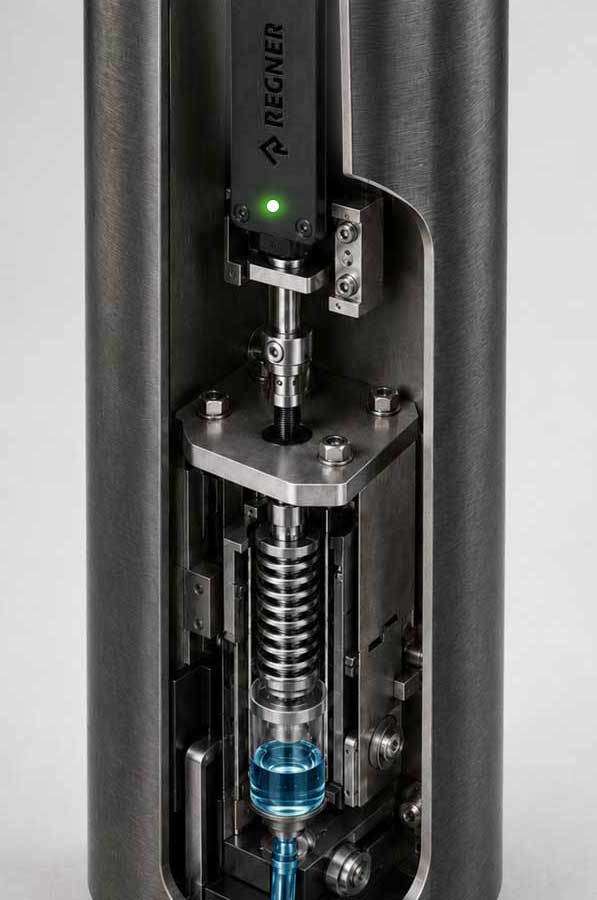
From this perspective, REGNER does more than develop electric actuators. The company designs motion solutions intended for integration into instruments where mechanical accuracy is just as important as the accuracy of the sensor itself.
These solutions can be used for dosing, positioning, adjustment and actuation functions, providing analytical instrument manufacturers with a compact and flexible alternative.
The objective is to ensure that every movement is performed in a controlled, repeatable and stable manner, even when the instrument must operate for extended periods without maintenance.
Applications in water analysers
Microactuation solutions are particularly relevant in analysers whose stability depends on the accuracy with which the following operations are performed:
- Dosing reagents.
- Moving internal components.
- Moving precision syringes.
- Actuating valves.
- Positioning optical elements.
- Automatically cleaning measurement cells.
- Performing calibration cycles.
In these applications, motion reliability directly affects equipment performance and the consistency of its results.
Integration for OEM manufacturers
Microactuation expands the possibilities available to original equipment manufacturers.
Each application has different requirements regarding travel, speed, force, size, power consumption, repeatability and service life. The motion system architecture must therefore be defined according to the actual requirements of the instrument.
Addressing integration from the earliest stages of the project makes it possible to adapt the solution to the available space, simplify the mechanism and reduce risks during industrialisation.
The motion system therefore ceases to be a component added at the end of the development process and becomes part of the equipment’s functional architecture.
The future of water analysis also depends on motion
For many years, innovation in water analysis has primarily been associated with the development of more accurate sensors and increasingly sophisticated algorithms.
The next generation of instruments will incorporate a third decisive element: motion systems capable of providing the same levels of accuracy, stability and reliability required by the measurement itself.
Analysers will continue to evolve towards more compact, connected and autonomous equipment. However, the quality of their results will still depend on every sample, every reagent and every movement being managed correctly.
Because the accuracy of an analyser depends not only on what it is capable of detecting, but also on how it moves to achieve it.
