

Expoquimia and Equiplast 2026: Water Cements Its Role as a Strategic Pillar of the Process Industries
Regner® Editorial Team
Aiguaviva -
10/07/2026
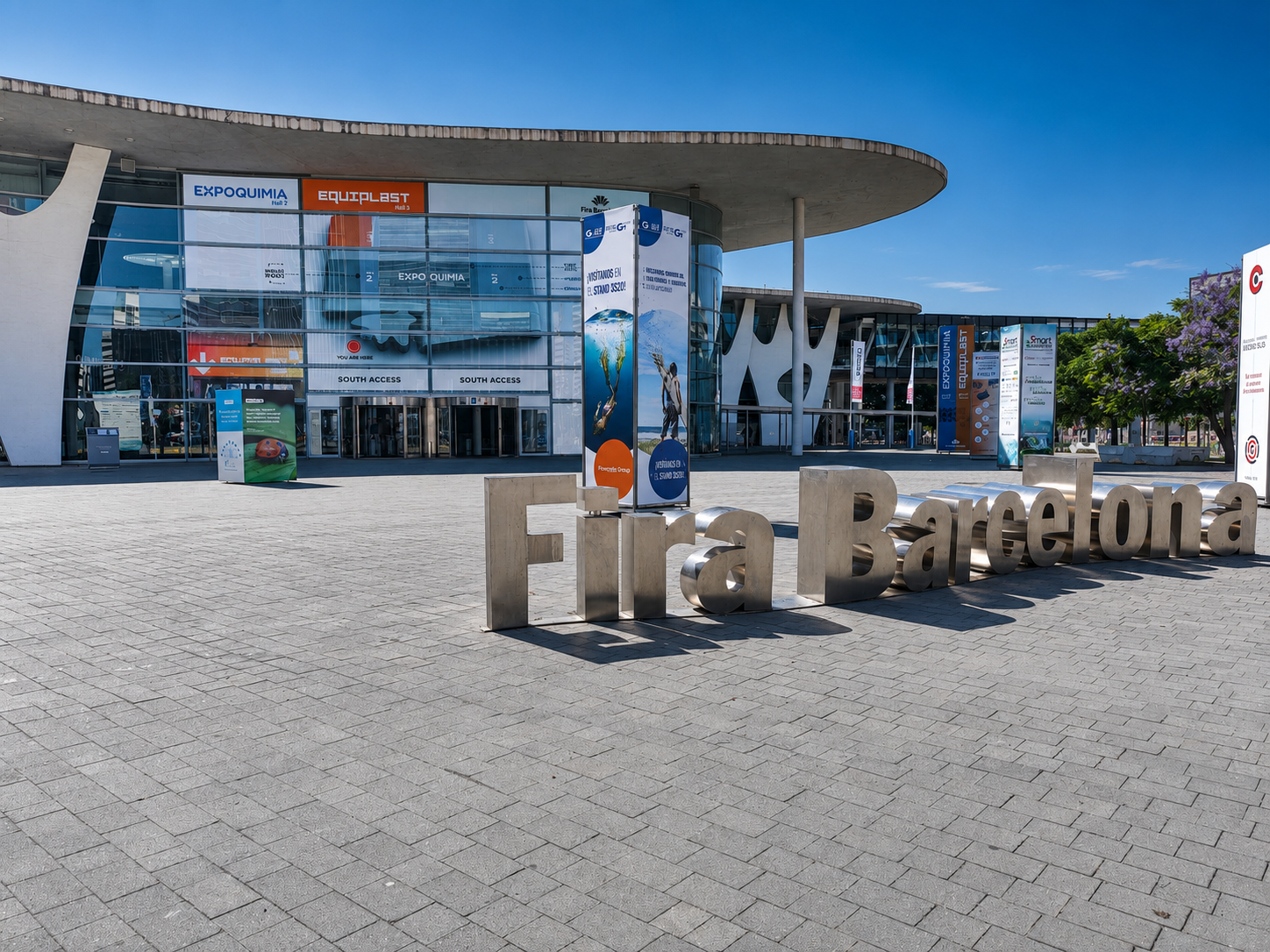
Expoquimia and Equiplast 2026
The joint edition of Expoquimia and Equiplast 2026 confirmed that water management is no longer an isolated field. Today, it is a cross-industry challenge that requires greater monitoring, automation and precise fluid control.
From 2 to 5 June 2026, Fira Barcelona hosted a new joint edition of Expoquimia and Equiplast. Both events are key meeting points for the chemical, plastics, rubber and process industries.
In addition, the event marked the 60th anniversary of Expoquimia and the 40th anniversary of Equiplast. More than 800 exhibiting companies took part. The programme also featured around 200 activities and brought together 400 experts.
Beyond the figures, the event delivered one particularly relevant conclusion. Water has become one of the main drivers of transformation across the process industries.
Expoquimia and Equiplast 2026: Water as a Cross-Industry Priority
The Expoquimia and Equiplast 2026 programme focused on four main areas: decarbonisation, circular water management, materials innovation and advanced digitalisation.
The prominence of water within this industrial agenda is no coincidence. On the one hand, water scarcity is forcing industries to use resources more efficiently. On the other, the European regulatory framework is increasing requirements for control and reuse.
As a result, industrial facilities need to measure more parameters and do so more frequently. In addition, they must guarantee increasingly high levels of reliability.
Treatment plants, laboratories and distribution networks require accurate information on numerous variables. These include residual chlorine, phosphates, ammonium, turbidity and specific contaminants.
However, behind every data point lies a chain of physical operations. All of them must be performed correctly.
Data Quality Begins Before the Sensor
Before producing a reading, an instrument must collect and move a sample. It must then mix it with controlled amounts of reagents and transport it to the measurement area.
For example, even a slight deviation in volume can alter the result of a colourimetric analysis. Similarly, continuous chemical overdosing can increase operating costs. Moreover, it can cause unnecessary environmental impact.
Therefore, data reliability does not depend solely on the sensor or the software. It also depends on the mechanics that make every analytical cycle possible.
Ultimately, moving, dosing and controlling fluids repeatably is essential for obtaining reliable measurements.
What OEM Manufacturers Need Today
Manufacturers of analytical instrumentation and treatment equipment are focusing their requirements on four main areas:
- Miniaturisation: equipment must integrate more functions into increasingly limited spaces.
- Long-term repeatability: each cycle must remain stable over thousands or millions of operations.
- Reduced consumption: using less sample and fewer reagents lowers costs and improves sustainability.
- Simplified integration: manufacturers need validated subsystems that reduce technical risk and accelerate development.
Therefore, the boundary between the component and the subsystem is shifting. Supplying a motor, lead screw or mechanical guide is no longer enough.
Instead, manufacturers need integrated solutions. These must combine mechanics, electronics, control and application expertise.
From Component to Validated Subsystem
Integrating several elements into a single subsystem reduces the complexity of the final equipment. It also simplifies industrialisation.
For an OEM manufacturer, a previously validated solution offers clear advantages. For example, it reduces engineering time and simplifies integration testing. It also lowers the risks associated with series production.
This capability is particularly relevant in water analysers and dosing equipment. It is also essential in sample preparation systems and laboratory instrumentation.
In all these applications, every movement must be performed in a controlled manner. Furthermore, performance must remain stable throughout the device’s service life.
Applying REGNER’s Experience to Precise Fluid Control
REGNER has more than three decades of experience in motion systems. During this time, the company has worked with OEM manufacturers of analytical instrumentation, medical devices and industrial applications.
Today, this industrial experience is also channelled through Magtiq. The start-up specialises in microactuation and fluid control technologies. Moreover, it builds on the technical and industrial knowledge accumulated by REGNER.
The solutions developed combine motorisation, precision mechanics, electronics and control. In this way, they create compact architectures ready for integration into the customer’s device.
One application is the actuation of syringe pumps in colourimetric water analysers. In these systems, motion resolution directly influences every analytical cycle. Likewise, stroke repeatability is essential for maintaining accuracy.
The same principle applies to sample preparation and reagent dosing. It also enables the control of microflow rates and other operations in analytical, medical and laboratory instrumentation.
All these solutions are backed by REGNER’s industrial capabilities. The company manufactures in Girona under management systems certified to ISO 9001, ISO 13485 and ISO 14001.
In addition, REGNER supports each project from the initial design and prototyping stages. It then provides assistance throughout industrialisation and series production.
A More Compact, Automated and Connected Industry
Expoquimia and Equiplast 2026 confirmed the convergence between process chemistry, analytical instrumentation, automation and water management.
Equipment is evolving towards more compact, connected and autonomous architectures. Digitalisation and artificial intelligence will expand its ability to interpret data and optimise processes. However, the value of that data will continue to depend on the correct control of every sample, reagent and movement.
Data quality begins with the physical system that generates it.
At REGNER, we continue to develop knowledge, industrial capabilities and new technologies. Our goal is to help OEM manufacturers integrate compact, repeatable and reliable motion into their devices.
Are you developing analytical instrumentation, a dosing system or water treatment equipment?
Our team can support you from the initial definition of the application. We can also provide assistance throughout validation and series production.
