What is a linear actuator? How does it work and how do you choose the right one?

Regner® Editorial Team

Aiguaviva -

19/02/2016

LINEAR-ACTUATOR-INFOGRAPHICS-1

A linear actuator is a device that generates motion in a straight line to move, lift, position, push or adjust a load. When this movement is produced by an electric motor, it is known as an electric linear actuator, a solution widely used in industrial equipment, medical devices, laboratory systems and many OEM applications.

This guide explains how an electric linear actuator works, its main components and the key parameters to consider when selecting the most suitable actuator according to force, speed, stroke, duty cycle, environment and control requirements.

Linear Actuator Assembly

What Is an electric linear actuator?

An electric linear actuator converts electrical energy into mechanical linear motion. It typically uses an electric motor to generate rotary motion and a transmission system, such as a spindle and nut, to convert that rotation into the linear displacement of a rod or moving element.

The main advantages of electric linear actuators include:

  • Clean and quiet operation
  • Precise motion control
  • Easy integration with electronic systems
  • Position, speed and force control depending on the configuration
  • Compact and flexible installation
  • Wide customisation possibilities
  • Low maintenance compared with some hydraulic or pneumatic solutions
  • Good energy efficiency when correctly sized for the application

One of the main advantages of electric linear actuators is their adaptability. Parameters such as force, speed, stroke, retracted length, supply voltage, control systems, connectors and mounting options can be configured to simplify integration into the final equipment.

For this reason, electric linear actuators are used in a wide range of applications, including industrial machinery, medical equipment, laboratory and analytical systems, special vehicles and OEM products that require precise and repeatable linear motion.

How does a linear actuator work?

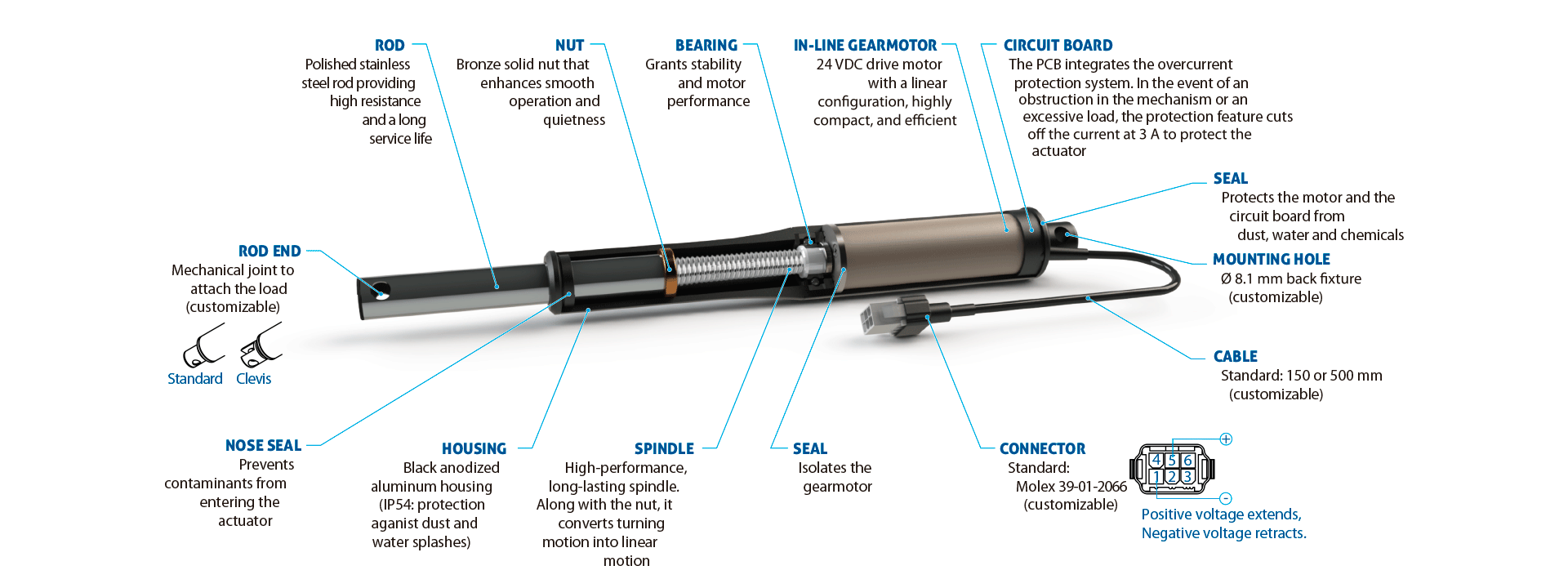
In an electric linear actuator, the motor generates rotary motion that is transmitted to a spindle. As the spindle rotates, a nut travels along its axis and converts the rotational movement into linear displacement. This movement is transferred to the rod or moving element of the actuator, which then pushes, pulls, lifts or positions the load.

To ensure that the actuators can be used in different mounting configurations, rods can be fitted with different types of ends, including mounting holes, clevises, threaded ends and T slots.

Actuators can also incorporate overcurrent protection systems. These systems interrupt the power supply if the actuator becomes obstructed or subjected to an excessive load. Robust housings and seals can protect the internal components against dust and water.

Connectors, cable lengths and mounting brackets can be customised according to the requirements of each application.

One of the main characteristics of a linear actuator is the position of its motor. The motor can be mounted perpendicular to the lead screw axis, using an additional transmission stage, or aligned with the lead screw axis. Actuators with the second configuration are known as inline actuators.

The inline configuration reduces the overall dimensions of the actuator and is particularly suitable for installations where space is limited or where a more streamlined design is required.

How to choose a linear actuator for your application

Choosing a linear actuator should not be based only on maximum force or stroke. The correct selection requires considering the complete operating profile, including load, speed, stroke, duty cycle, available space, power supply, environmental conditions and control requirements.

Defining these parameters accurately helps avoid unnecessary oversizing, improves system reliability and makes it easier to integrate the actuator into the final equipment.

  1. Force or load.This is the force, expressed in newtons, required for the actuator to operate correctly. It is determined by the weight of the object being moved, the load supported by the actuator, the transmission angle, torque and friction. Accurately defining this value is essential for optimising the actuator configuration. Overestimating the required load may result in an actuator that is slower or more powerful than necessary, increasing the cost and weight of the equipment. Conversely, underestimating the load may cause overloads or reduce the actuator’s service life.
  2. Speed. This is the speed at which the linear actuator must move, normally expressed in millimetres per second. Force and speed are directly related to power. The approximate motor power required can therefore be calculated from these two values.
  3. Stroke. The stroke is the distance that the load must travel, normally expressed in millimetres. This parameter directly affects the overall dimensions of the actuator.
  4. Retracted length between mounting centres.This is the distance between the two mounting points when the rod is fully retracted. This measurement is essential when planning how the actuator will be integrated into the assembly and must be determined in relation to the required stroke.
  5. Power supply.Determine whether the application requires direct current, DC, or alternating current, AC. You must also specify the operating voltage, expressed in volts, and, when necessary, the electrical current, expressed in amperes.
  6. Duty Cycle.The duty cycle is the percentage of time during which the actuator can remain active within a complete operating period. For example, an actuator that operates for 2 minutes during a 20 minute period has a duty cycle of 10%.
  7. Operating environment. The required level of protection depends on the environment in which the actuator will operate. A lower ingress protection rating may be suitable for indoor applications. Outdoor applications or environments exposed to dust and water require a higher IP rating.
  8. Control. Depending on the final application, the actuator may require additional control features, such as limit switches, position feedback devices, control boxes or electronic controllers.
  9. Connectors and mounting components.Cable lengths, connectors, mounting holes, rod ends, brackets and housing colours must be specified to ensure seamless integration into the final assembly.
  10. Technical support. If you still have questions or require further information, please contact us. Our team will help you identify the most suitable linear actuator for your application.
ACTUATOR-VERTICAL

The following table summarises the main parameters that should be defined before selecting an electric linear actuator.

PARAMETER WHAT TO DEFINE WHY IT MATTERS
Force Actual load and forces acting on the system Determines the required actuator capacity
Speed Required linear travel speed Influences movement time and mechanical power requirements
Stroke Total travel distance Defines the required movement range and affects actuator dimensions
Retracted length Available space between mounting points Helps determine whether the actuator fits within the equipment
Power supply Voltage, nominal current and starting current Allows the power supply to be correctly sized
Duty cycle Operating time and movement frequency Helps manage temperature, performance and service life
Environment Dust, water, temperature, chemicals and cleaning conditions Determines the required protection level and material selection
Control Position feedback, sensors, limit switches and control requirements Defines how the movement is monitored and controlled
Integration Connectors, cables, mounting points and available geometry Facilitates integration of the actuator into the final product
Specific requirements Noise, precision, repeatability, expected service life and regulatory requirements Ensures the actuator is adapted to the real operating conditions of the application

Frequently Asked Questions About Linear Actuators

What is a linear actuator?
A linear actuator is a device that generates movement in a straight line to move, lift, push, pull or position a load. Electric linear actuators use a motor and a transmission system to convert rotary motion into linear motion.

How does an electric linear actuator work?
An electric motor rotates a spindle, causing a nut to move along its axis. This converts rotary motion into linear displacement, which is transferred to the actuator rod or moving element.

What information is needed to choose a linear actuator?
The main parameters are force, speed, stroke, duty cycle, available space, power supply, environmental conditions and control requirements.

Can a linear actuator be customised?
Yes. Depending on the application, force, stroke, speed, mounting, connectors, cables, feedback systems and other mechanical or electrical characteristics can be adapted to the equipment.

Share this article!

×ATENCIÓ: Cookies no configurades en l'idioma actual. Revisa la teva configuració al plugin, gràcies!