

Precision machining in actuator manufacturing: REGNER at AMB Stuttgart 2026
Regner® Editorial Team
Aiguaviva -
02/10/2026
When discussing an electric linear actuator, attention usually focuses on the motor, lead screw, electronics or control system. Yet a significant part of its performance depends on much less visible elements: the machined parts that locate, support and maintain the alignment of all these components.
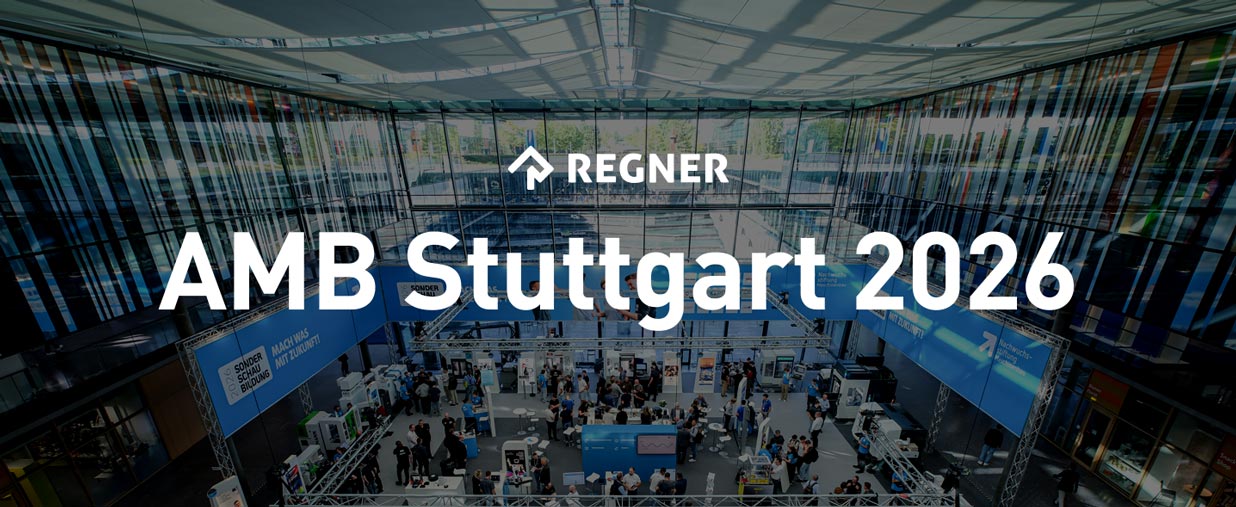
For this reason, REGNER’s visit to AMB Stuttgart 2026 is about more than discovering new machine tools. The international exhibition for metalworking, which held its 22nd edition from 15 to 19 September at Messe Stuttgart with 1,195 exhibitors from 34 countries, provides an opportunity to examine how manufacturing technologies are evolving to produce components that are increasingly precise, repeatable and adaptable to different actuator designs.
At this edition, we once again visited the DATRON stand (Hall 7, stand 7B21). This manufacturer of high-speed CNC milling machines supplies technology that we have been using for more than a decade and that forms part of our actuator manufacturing processes.
Why machining precision influences actuator performance
An electric linear actuator converts the rotation of a motor into controlled linear motion, usually through a lead screw and a mechanical transmission. It is a mechanical assembly in which different components must retain their positions and work together throughout the product’s service life. The final result depends not only on the precision of each individual part, but also on the geometric relationships between them.
The position of a machined seat can affect how a bearing is fitted; a datum surface determines the position of other components, and alignment between different elements influences how motion is transmitted. When these geometric relationships deviate from the intended specifications, increased friction, unwanted stresses, wear or reduced repeatability can occur.
In actuator manufacturing, machining is therefore not simply a stage in the production of a part. It contributes to the product’s functional performance.
At REGNER, we also work with small components, tight tolerances and a wide range of part numbers. This requires a combination of precision and flexibility to manufacture prototypes, small batches, specific variants and repeat production runs while maintaining process stability.

In-house actuator manufacturing and product engineering
Retaining in-house machining capability is also important during development. When a geometry, position or tolerance is modified during actuator design, the ability to manufacture and validate a new version internally shortens the cycle between design, manufacturing and testing. Machining thus becomes not only a production technology, but also an engineering tool.
This is particularly useful when developing custom actuators or adaptations for integration into the customer’s equipment. A seemingly minor modification to a part may require assembly, tolerances and operation to be checked again before it is incorporated into the final design.
More than ten years manufacturing actuators with DATRON technology
This need to combine precision, speed and flexibility led us to discover DATRON in 2012. Before making a decision, we visited the company’s premises at the time in Mühltal-Traisa, near Darmstadt (Germany), to take a closer look at its machines and its approach to machining.
That visit led to the acquisition of our first DATRON machine. Others followed. More than ten years later, these machines remain part of our daily production and our ability to manufacture precision components in-house.
One interesting aspect of DATRON’s approach is that the machine is not considered in isolation. Tools, workholding systems, software and machining strategy form part of a single process, particularly suited to the high-speed machining of materials such as aluminium, plastics and composites.
For a company working with numerous part numbers, this approach is especially important. Productivity does not depend solely on the time a tool takes to machine a part; set-up, workholding, changeovers between part numbers, programming and the ability to repeat the process also play a role.
At AMB 2026, we also had the opportunity to meet Michael Hoffarth, Key Account Sales Manager at DATRON AG, and discuss the company’s development and some of the new products and developments presented in Stuttgart this year.
DATRON at AMB 2026: the new MLmax Pro
The main new product presented by DATRON at AMB 2026 was the DATRON MLmax Pro, a large-format milling machine designed for sheet material and large workpieces, with a working area of 1,500 × 3,000 mm and travel speeds of up to 50 m/min.
It is interesting to see how DATRON has transferred principles it has been developing for years to a larger-format machine: high-speed machining, precision, ease of use and integration between machine, tool, software and process.
The development of DATRON next, its control system, follows the same direction. As a machine incorporates more mechanical systems, sensors, drives, electronics and software, an important part of the engineering work is precisely to ensure that this complexity is not passed on to the operator.
In industrial environments with frequent changeovers between part numbers, the ability to set up, control and repeat a process easily is just as important as certain individual machine specifications.

From machining to the actuator’s final performance
AMB Stuttgart offers an insight into new manufacturing technologies, but also highlights the extent to which an industrial product’s performance depends on how its components are manufactured.
In an actuator, every machined part forms part of a dimensional and functional chain. Its geometry, position and relationship with the other components influence assembly and the subsequent behaviour of the complete unit.
For REGNER, having machining technology therefore means more than simply manufacturing parts in-house. It also means retaining control over a part of the process that determines how our actuators function, and having greater capacity to develop, modify and validate new designs.
More than ten years of using DATRON technology at our plant have enabled us to see the value of its approach. At AMB 2026, we saw how its advances continue to meet our requirements for precision and flexibility in design and manufacturing.
