

From prescription to dose: microactuation for the manufacture of personalised medicines
Regner® Editorial Team
Aiguaviva -
15/06/2026
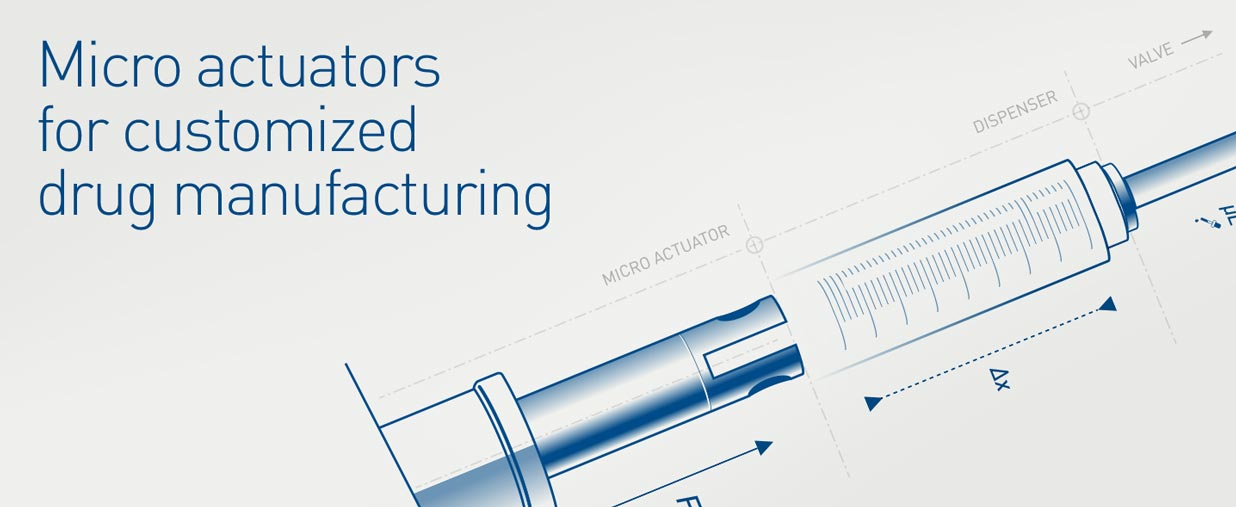
Micro actuators for dosing drive syringes and pistons in pharmaceutical and laboratory equipment. In the preparation of personalised medicines, their integration requires motion, the fluid circuit, sensors and control to be coordinated to achieve a repeatable and verifiable process. This article examines the criteria an integrator needs to consider, from force and available space to fault detection and maintenance.
1. From mass production to the preparation of personalised medicines
For more than a century, the pharmaceutical industry has refined a model based on scale: tightly controlled processes capable of manufacturing large volumes of standardised medicines. That model remains essential, but it no longer meets all the needs of modern medicine on its own.
In oncology, paediatrics, advanced therapies and certain hospital treatments, the dose or even the formulation may depend on patient-specific variables: weight, body surface area, age, renal function, therapeutic response or molecular characteristics.
The consequence is not simply a need to manufacture smaller batches. The more fundamental change lies in the workflow. Automation must be able to handle different recipes, different materials and different process sequences without losing traceability, repeatability or control.
In liquid processing, this change has been visible for years. Automated systems prepare intravenous admixtures, oncology treatments, samples, reagents and individualised formulations from a digital order. In parallel, new developments are exploring the manufacture of personalised medicines through precision dosing, controlled deposition and additive manufacturing.
From an automation integrator’s perspective, the challenge is not to build a machine that performs a single movement with great precision. It is to design a complete system in which every movement fits within a reproducible, verifiable and maintainable workflow.
2. From linear displacement to dispensed volume
At some point in any automated process, the software stops working solely with data and must act on the physical world. The system can calculate that 0.15 ml of an active ingredient is required, identify the correct vial, check the concentration and record the batch. Ultimately, however, a mechanism has to displace that volume.
When syringes, cartridges, pistons or dosing chambers are used, a seemingly simple physical chain emerges:

Linear displacement → displaced volume → dispensed quantity
The difficulty is that a real machine never operates under ideal conditions. Loads change, syringes have tolerances, fluids present different levels of resistance, components deform slightly, and the process must remain repeatable after thousands or hundreds of thousands of cycles.
For an integrator, the question is therefore not simply ‘What resolution does the actuator have?’ The question is much broader: ‘How does this subsystem behave within the machine, under load, throughout its service life and when something stops working as intended?’
3. How to select a micro actuator for dosing
A micro actuator may have excellent specifications on paper and still be difficult to integrate. In a pharmaceutical or laboratory platform, motion forms part of a much larger architecture that brings together robotics, liquid handling, vision, valves, pumps, sensors, racks, code readers, control software and traceability systems.
From this perspective, several questions arise before selecting a drive:
Does it actually fit where it needs to operate?
The space it occupies, its geometry and orientation, access to connectors and the ability to replace the module are just as important as its rated force.
Does it deliver the required force throughout the stroke?
Backpressure can vary with viscosity, syringe diameter, a needle, a filter, a valve or the geometry of the circuit itself.
Is the motion repeatable under load?
Backlash, elasticity, stiffness, cycle-to-cycle variation and changes caused by wear can directly affect process behaviour.
Can we determine its actual position?
In certain applications, commanding a displacement is not enough; it is necessary to confirm position, detect the end of travel or verify that the mechanism has followed the intended profile.
What happens when something goes wrong?
A system suitable for automation must enable, or at least facilitate, the detection of jams, overloads, position deviations or abnormal behaviour.
Can it be maintained and validated?
Accessibility, replacement, calibration, service life and consistency between units are part of the system design, not matters to be addressed afterwards.
4. Dosing accuracy: mechanics, sensors and control
In dosing, final accuracy does not depend exclusively on the actuator. It depends on the combination of drive, syringe, fluid path geometry, valves, sensors, control strategy and calibration process. This distinction is important.
An encoder can indicate the mechanism’s position with great accuracy, yet the actual volume may still vary if there is compressibility in the circuit, syringe deformation, trapped air or a change in hydraulic resistance. Similarly, motor current can provide useful information about the load, but it needs to be interpreted within the system’s mechanical context.
The integrator’s task is precisely to combine these signals. Depending on the application, position, current, force, pressure, flow rate or mass can be used to check that the physical process matches what the digital recipe expected.
The architecture then moves beyond an open-loop command such as ‘advance 2 mm’ and can evolve towards supervised control logic:

process command → motion → measurement → verification → next step
This loop is particularly valuable in equipment that must operate autonomously for hours, process different samples and record what happened in each cycle.
5. Integrating micro actuators into pharmaceutical and laboratory equipment
This is where a well-designed microactuation solution can significantly reduce integration work. Rather than treating the motor, transmission, lead screw, guidance, feedback and electronics as independent parts, certain architectures can combine some of these functions within a compact, characterised subsystem.
At REGNER, we develop microactuation solutions for scientific, analytical and medical instrumentation, with applications in equipment from companies such as BANDELIN, ONCOSEM, Revvity and Technobis. The experience we have gained in this type of instrumentation leads us to approach the micro actuator not as an isolated component, but as a part that must be integrated into a complete machine.
For the instrument designer, the value lies not only in having a small mechanism. It lies in being able to clearly define the relationship between force, stroke, speed, resolution, repeatability, service life, feedback and control interfaces, within the available space.
In syringe-based or piston-based applications, this approach allows the mechanics to be adapted to the syringe diameter, target volume, expected backpressure and actual duty cycle. It also allows this to be done from the start of the design process, before the drive becomes a constraint that forces the rest of the platform to be redesigned.
6. Fault detection in automated dosing systems
In laboratory automation, a good system is not merely one that works when everything goes well. It is one that knows what to do when a syringe offers more resistance than expected, a mechanism fails to reach its position, a consumable is incorrectly fitted or an element of the circuit becomes blocked.
Motion engineering must therefore consider failure modes from the outset. Depending on the architecture, the system may use position feedback, current limits, force sensors, pressure sensors or flow sensors to stop the process, repeat an operation, reject a sample or generate an alarm before continuing.
This ability to diagnose behaviour is particularly important in machines that operate without continuous supervision. Accuracy is not just about reaching a nominal position; it is also about knowing when the process has deviated from it.
7. From prescription to a verifiable process
Personalised medicine is often associated with genomics, artificial intelligence, clinical software and new therapeutic models. Yet to become an industrial reality, it needs something more prosaic and equally decisive: physical processes that can be repeated, measured and verified.
Between a digital prescription and an actual dose lies a complete chain of operations: identifying, handling, opening, aspirating, displacing, mixing, dispensing, closing, measuring and recording. Microactuation contributes to some of these steps, but must do so as part of a larger system.
From an integrator’s perspective, that is the essential point: it is not enough for a mechanism to be precise in isolation. It must be compact, predictable, capable of integration and diagnosis, and robust enough to behave in the same way cycle after cycle.
The real challenge is not to move two millimetres. It is to move exactly as far as required, know that the movement has taken place, detect when it has not occurred as expected and repeat it throughout the machine’s service life.
This is where microactuation stops being simply a mechanical component and becomes part of the process architecture.
Contents
2. From linear displacement to dispensed volume
3. How to select a micro actuator for dosing
4. Dosing accuracy: mechanics, sensors and control
5. Integrating micro actuators into pharmaceutical and laboratory equipment
6. Fault detection in automated dosing systems
7. From prescription to a verifiable process
